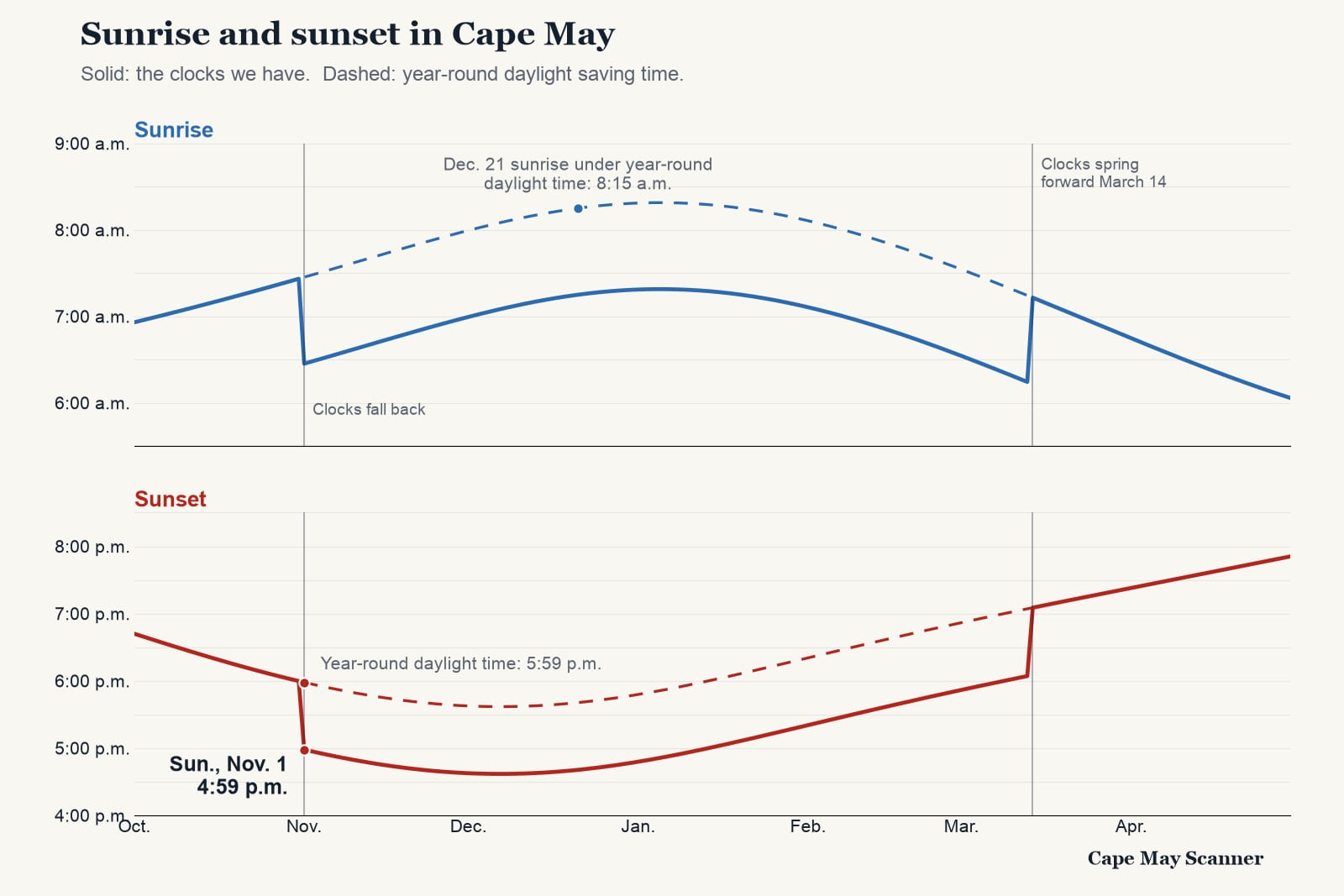
CAPE MAY, Oct. 31, 2026 — Daylight saving time ends at 2 a.m. Sunday, Nov. 1, when clocks fall back to 1 a.m. In Cape May, sunset moves from 6 p.m. Saturday to 4:59 p.m. Sunday.
The evenings keep getting darker from there. Sunset bottoms out around 4:37 p.m. in early December, and clocks spring forward again Sunday, March 14, 2027.
Permanent daylight saving time doesn't create more daylight; it shifts an hour of it from the morning to the evening by the clock. Under it, Sunday's sunset would come at 5:59 p.m. The tradeoff is in the morning: on Dec. 21, the sun wouldn't rise in Cape May until 8:15 a.m.
The Sunshine Protection Act
The House voted 308-117 on July 14 to make daylight saving time permanent nationwide, with majorities of both parties voting yes. Rep. Jeff Van Drew, who represents Cape May County, was among them. States would not get to choose. Only places already on standard time all year, such as Hawaii and most of Arizona, could stay that way, according to the bill text.
The bill is stuck in the Senate. Majority Leader John Thune said this month there is "no clear path forward," TIME reported, and no vote is scheduled. A similar bill passed the Senate in 2022 but died in the House.
19 states are waiting on Congress
Nineteen states have passed laws to switch to permanent daylight saving time if Congress allows it, according to the National Conference of State Legislatures: Alabama, Colorado, Delaware, Florida, Georgia, Idaho, Louisiana, Maine, Minnesota, Mississippi, Montana, Oklahoma, Oregon, South Carolina, Tennessee, Texas, Utah, Washington and Wyoming. In Idaho and Oregon, the laws cover only the parts of each state on Pacific time.
Federal law already lets a state stay on standard time all year, as Hawaii and most of Arizona do. It does not let a state stay on daylight time all year.
New Jersey is not on the list. A bill from Assemblywoman Verlina Reynolds-Jackson, A1703, would move the state to permanent daylight time if federal law changes. It has sat in committee since January. A competing bill from Sen. Shirley Turner, S293, would keep New Jersey on standard time year-round, an option current federal law allows but the House-passed bill would end.
How we got here
Benjamin Franklin often gets the credit, but his 1784 essay in the Journal de Paris was satire poking fun at late-sleeping Parisians. He never proposed changing the clocks, according to the Franklin Institute.
The modern idea came from New Zealand entomologist George Vernon Hudson, who proposed it in 1895, and British builder William Willett, who campaigned for it in the early 1900s. Germany adopted it first, in 1916, during World War I.
The United States followed in 1918 with the Standard Time Act, which also created the country's time zones. Congress repealed the daylight saving part in 1919 over President Woodrow Wilson's veto. The country went on year-round "War Time" from February 1942 to September 1945, and the Uniform Time Act of 1966 set a national schedule.
Year-round daylight time has been tried before. During the oil embargo, President Richard Nixon signed a law that put the country on daylight saving time all year starting in January 1974, as a two-year trial. Dark winter mornings, and reports of schoolchildren struck by cars on their way to school, turned the public against it. Standard time returned that October.
Today's schedule, from the second Sunday in March to the first Sunday in November, took effect in 2007 under the Energy Policy Act of 2005.
Sources: Government Publishing Office (H.R. 139 text); National Conference of State Legislatures; New Jersey Legislature; U.S. Naval Observatory; Congressional Research Service; Franklin Institute; TIME.