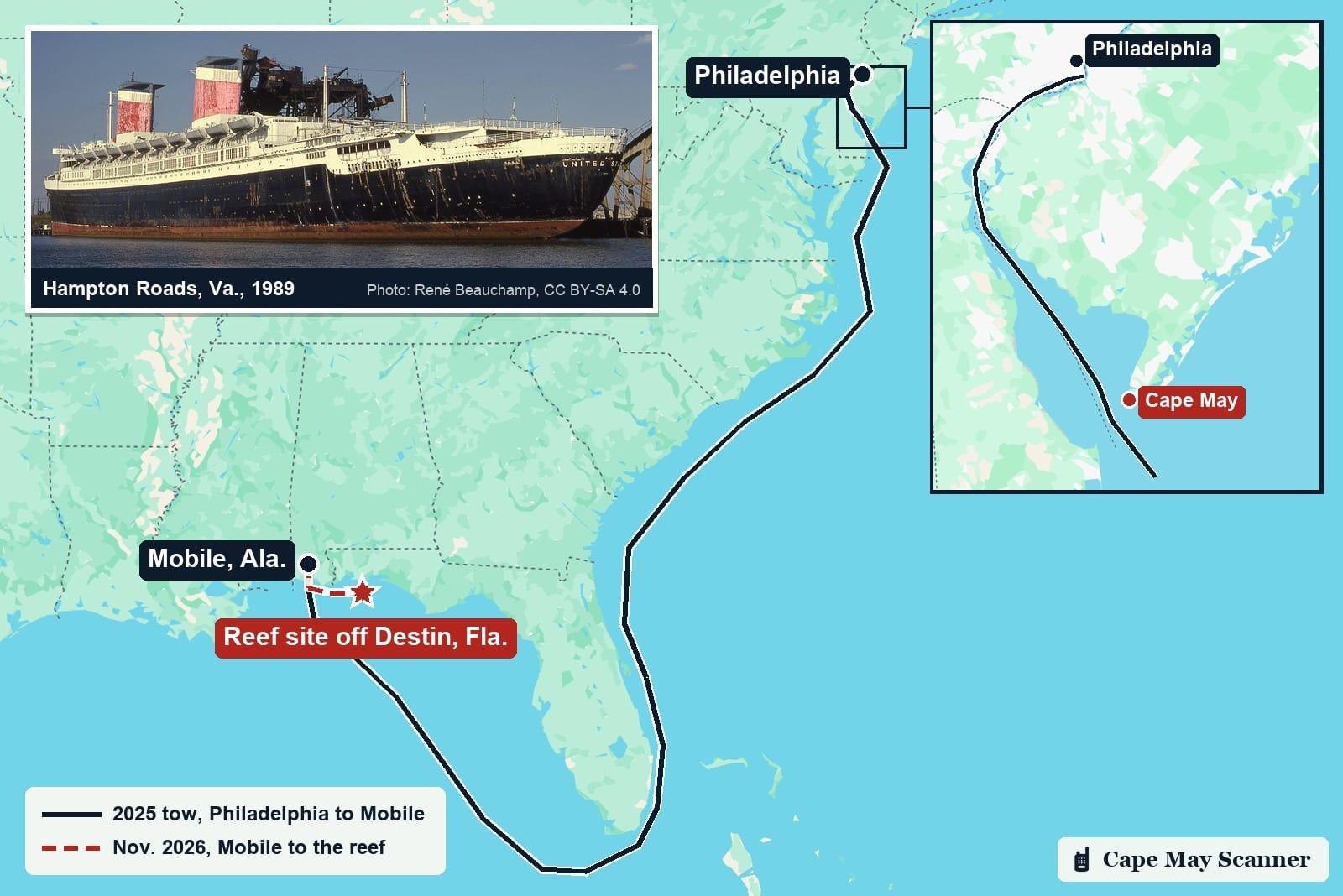
CAPE MAY, Nov. 11, 2026 — The SS United States, the ocean liner towed down the Delaware River and out past Cape May in February 2025, is scheduled to be sunk this afternoon in the Gulf off Destin, Fla., where Okaloosa County, Fla., says it will become the world's largest artificial reef.
Deployment operations are set to begin at 2 p.m. Eastern time (1 p.m. Central), county officials told WEAR-TV in Pensacola and WPVI-TV (6abc). The county moved the sinking up a day, from Thursday, because of forecast heavy winds and unsafe conditions.
"While the weather may have changed our plans, it has given this historic occasion an especially meaningful date," Okaloosa County Board Chairman Trey Goodwin said. "On Veterans Day, as we honor the men and women who served our nation, we will also honor the legacy of the SS United States."
How to watch
Destin-Fort Walton Beach, the county's tourism department, is streaming the deployment live on YouTube, with programming at 1 p.m. Eastern and the deployment at 2 p.m.
Where and how
The reef site is about 22 nautical miles southwest of Destin-Fort Walton Beach and 32 nautical miles southeast of Pensacola, at 30° 07.148' N, 86° 46.755' W, according to county figures published by the Pensacola News Journal. The coordinates could shift slightly after the ship settles. The ship left Mobile, Ala., under tow Monday morning.
Federal environmental and explosives rules keep the county and its contractor from using explosives, according to The Associated Press. Instead, valves will be opened so seawater floods the hull. Crews cut 10-foot-by-10-foot holes in the decks and removed more than 400 portholes, county spokesperson Nick Tomecek said. The ship should rest in about 180 feet of water, with its top deck about 60 feet below the surface. The project cost $13.5 million.
The sinking should take about 45 minutes, and the wreck opens to divers the next day, according to WALA-TV (FOX10) in Mobile.
"We're trying to be the best diving destination in the world," Tomecek said.
Efforts to stop it
The SS United States Preservation Foundation, a nonprofit, went to federal court in Pensacola on Nov. 3. It alleged the U.S. Army Corps of Engineers approved the project without an environmental impact statement and without completing a required historic preservation review, and it asked for an emergency order to stop the sinking.
U.S. District Judge M. Casey Rodgers denied that request on Nov. 6. The order found the "docket is void of a verified complaint and/or any affidavit attesting to the truthfulness" of the claims and also noted the "substantial expense" of keeping a ship that size berthed and that the foundation had not proposed a bond to cover it.
The foundation filed an amended request the same day. Rodgers denied it Nov. 7, calling the foundation's argument about the county's costs "rank speculation." The order left the door open to refile but said, "Any subsequent TRO must propose a bond amount sufficient to protect the county taxpayers." The county said it would keep moving forward.
An earlier challenge also failed. In August 2025, a federal judge in Florida dismissed a lawsuit by the New York Coalition to Save the Steam Ship United States, ruling the group lacked standing.
The Cape May leg
The liner had been docked in Philadelphia since 1996. Tugs began moving it down the Delaware River around noon on Feb. 19, 2025. Hundreds of people lined Freedom Pier in Gloucester City to watch, and the ship reached Delaware Bay by 9:30 p.m. It was expected to pass Cape May on Thursday, Feb. 20, 2025, on its way down the coast to Mobile.
The ship
The liner's 1952 maiden voyage set a speed record, averaging almost 41 mph and beating a 1938 record held by Britain's RMS Queen Mary.
The SS United States Conservancy has preserved the ship's funnels and is developing an SS United States museum in Okaloosa County.
"It was our goal to make sure that she wasn't lost forever," Conservancy board member David Lawrence said.
"She really embodies and expresses this country's best," said Susan Gibbs, granddaughter of the ship's designer.