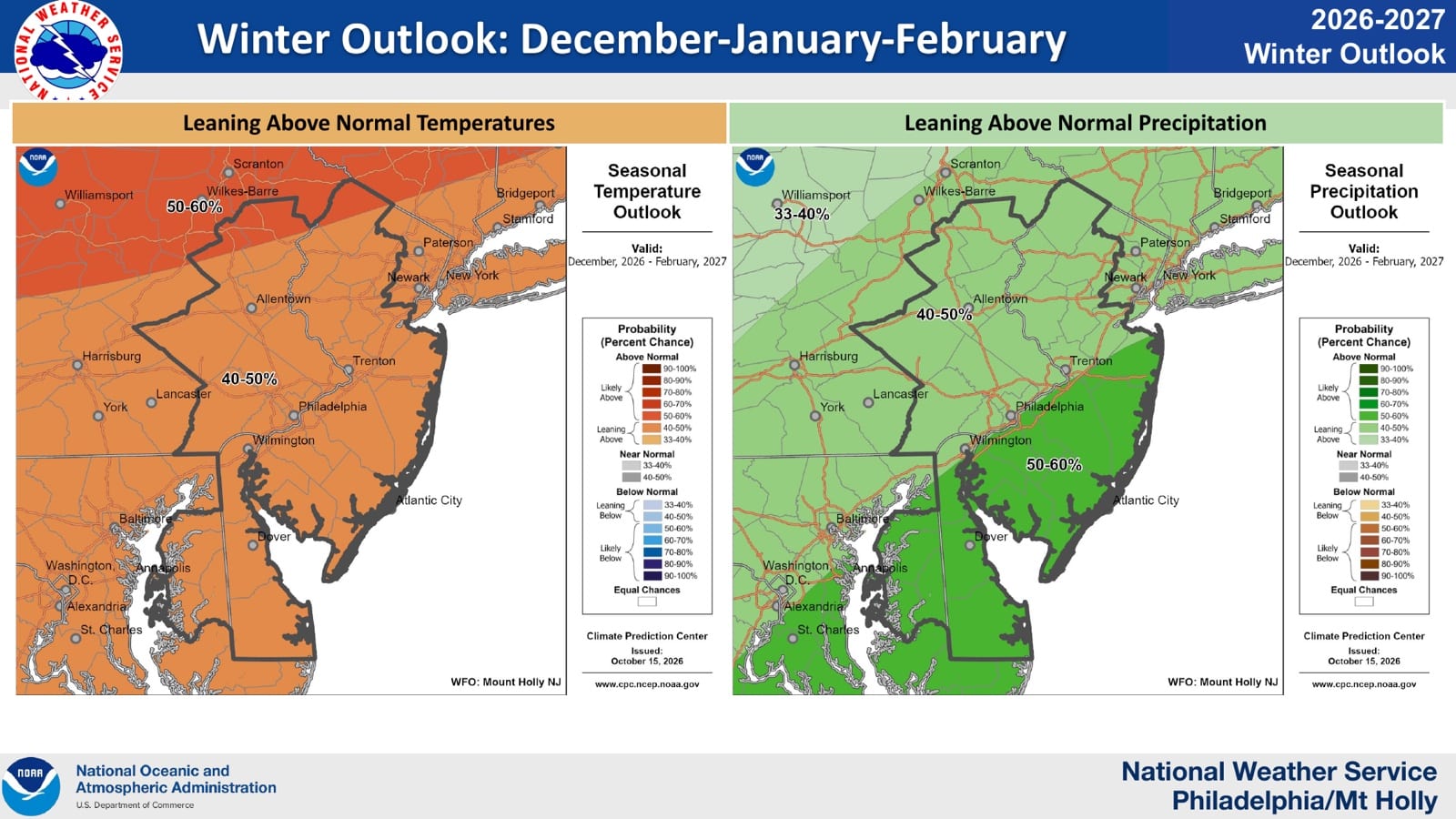
CAPE MAY COURT HOUSE, Nov. 7, 2026 — A strong El Niño in the Pacific tilts the odds toward a wetter and milder winter in Cape May County, but it says little about how much snow will fall, according to a winter outlook the National Weather Service in Mount Holly published Saturday.
The El Niño is still strengthening and is likely to stay strong to very strong through January–March 2027, forecasters say. By one September measure it is the second warmest since 1950, behind only 1997.
The federal Climate Prediction Center's outlook for December through February gives Cape May County a 50% to 60% chance of above-normal precipitation and a 40% to 50% chance of above-normal temperatures.
At Atlantic City International Airport in Pomona, the closest station in the analysis, the nine strong and very strong El Niño winters since 1957 averaged 22.5 inches of snow, above the normal of 17.4 inches. The range was enormous: 0.4 inches in 1972-73, the second-least snowy winter there since 1944, and 58.1 inches in 2009-10, the snowiest since 1944.
Counting only the six very strong El Niño winters, the average drops to 13.3 inches. The last two brought 3 inches in 1997-98, from a single measurable snowfall, and 27.5 inches in 2015-16, when 12.9 inches fell in one storm Jan. 22–24.
None of those winters produced a 20-inch snowstorm at Atlantic City. They averaged 1.6 storms of 6 inches or more, and winter precipitation averaged 12.4 inches, above the normal of 11.08.
El Niño "shifts the odds rather than guarantees an outcome," the weather service says. Coastal storms are favored, but the cold air needed to turn them to snow is often missing, so strong El Niño winters "have produced both little to no snowfall and historic snowfall." Below-normal snowfall is generally favored in very strong El Niño winters unless a major storm hits, and "several minor snow events are unlikely," forecasters say.